
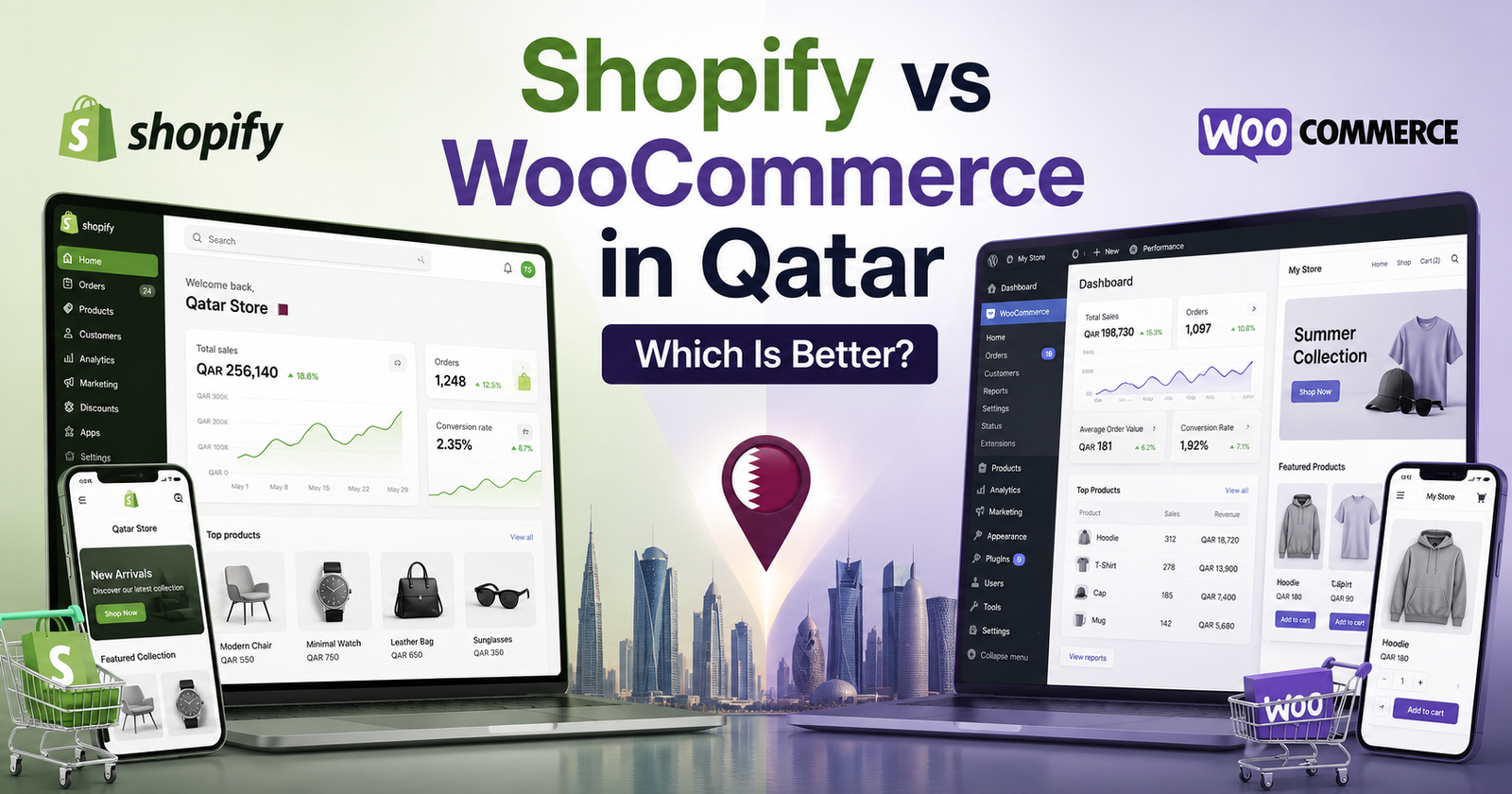
Shopify vs WooCommerce in Qatar is one of the first comparisons business owners make before launching an online store. Both platforms can sell products successfully, yet they work in very different ways.
Shopify is a hosted ecommerce platform. Therefore, hosting, security updates and most technical maintenance are managed for you. WooCommerce, by contrast, is an open-source ecommerce platform built on WordPress, so you choose the hosting, design, plugins and technical setup.
The better option depends on your budget, technical ability, payment gateway, Arabic requirements, SEO plans and long-term growth. In this guide, we compare both platforms specifically for ecommerce businesses operating in Qatar.
Shopify vs WooCommerce in Qatar: Quick Answer
Choose Shopify when you want the quickest setup, a simple dashboard, managed hosting and less technical responsibility.
Choose WooCommerce when you want greater control over design, SEO, payment integrations, Arabic content and future customisation.
For many small catalogue stores, Shopify is easier. However, for businesses that treat SEO, custom features and long-term control as priorities, WooCommerce is often the stronger investment.
Shopify and WooCommerce: What Is the Difference?
Shopify
Shopify provides the store software, hosting, checkout and security within one subscription. As a result, a merchant can launch without arranging separate hosting or managing WordPress updates.
- Hosted, all-in-one platform
- Beginner-friendly dashboard
- Managed security and updates
- Apps add extra functionality
- Monthly subscription required
WooCommerce
WooCommerce is a free, open-source ecommerce plugin for WordPress. However, the merchant must arrange hosting, maintenance and any premium extensions required by the store.
- Self-hosted and open source
- Full control over website and data
- Highly customisable
- Large plugin and theme ecosystem
- More technical management required
WooCommerce officially describes its core platform as free and open source, while merchants choose their own host, payment provider and extensions. Shopify, meanwhile, bundles the platform and hosting into a subscription. You can review the official WooCommerce pricing explanation and Shopify pricing page.
Which Platform Is Easier to Use?
For ease of use, Shopify is the clear winner for most beginners. You create an account, select a theme, add products, configure delivery and connect a supported payment provider. Furthermore, the admin area is consistent because Shopify controls the platform.
WooCommerce takes more preparation. First, you need a domain and hosting. Next, WordPress and WooCommerce must be installed and configured. You may also need plugins for security, backups, SEO, caching, multilingual content and payment integration.
Nevertheless, the additional setup gives you more control. A competent developer can change almost every part of a WooCommerce store. Consequently, Shopify vs WooCommerce in Qatar is partly a choice between convenience and control.
Shopify vs WooCommerce Cost in Qatar
The cost comparison is not as simple as “Shopify is paid and WooCommerce is free.” Shopify has a predictable subscription, although paid apps, premium themes and third-party transaction fees can increase the final cost. WooCommerce core is free, but hosting, premium plugins, security and maintenance can add ongoing expenses.
Typical Shopify costs
- Monthly Shopify subscription
- Premium theme, when required
- Paid apps for additional features
- Payment gateway processing fees
- Possible Shopify third-party transaction fee
- Developer cost for advanced customisation
Typical WooCommerce costs
- Domain and hosting
- Premium theme, when required
- Paid plugins or annual extensions
- Payment gateway processing fees
- Security, backup and performance tools
- Developer or maintenance support
At the time of review, Shopify’s public pricing materials listed its core ecommerce plans with monthly subscription charges, while Shopify noted that pricing and payment options may differ by country and billing cycle. Therefore, businesses should confirm the exact Qatar-facing price before subscribing.
WooCommerce says its core platform has no monthly subscription. However, its official cost guide shows that hosting and extensions can range widely depending on store traffic and functionality. As a result, a simple WooCommerce site may be economical, while a complex high-traffic store can still require a significant budget.
Payment Gateways for Shopify and WooCommerce in Qatar
Payment gateway compatibility is one of the most important Qatar-specific factors. Shopify Payments is only available to businesses located in countries on Shopify’s supported-country list. Qatar was not listed as a Shopify Payments country when this guide was reviewed. Therefore, a Qatar-registered Shopify merchant generally needs a supported third-party payment provider.
This matters because Shopify may charge third-party transaction fees based on the selected plan, in addition to the payment provider’s own processing fees. Shopify’s official documentation confirms that third-party transaction fees can apply when an external provider processes an order.
WooCommerce does not add a platform-level transaction fee. Instead, the merchant pays the selected payment provider and any costs associated with the relevant plugin or integration. Moreover, WooCommerce allows a developer to build or install integrations with a wider range of providers.
Qatar merchants may investigate providers such as QNB QPay, SkipCash, Tap Payments, MyFatoorah or PayTabs. However, compatibility with Shopify or WooCommerce, payment methods and commercial approval must be confirmed directly with each provider.
For a detailed comparison, read our guide to the best payment gateways for ecommerce websites in Qatar.
Arabic and Multilingual Ecommerce Support
Both platforms can support Arabic and English, although the setup differs. Shopify supports multiple languages through its platform features, compatible themes and translation apps. Nevertheless, the selected theme must be tested carefully for right-to-left layout, navigation, product pages and checkout presentation.
WooCommerce can use multilingual plugins and RTL-compatible WordPress themes. In addition, store owners have greater control over Arabic URLs, translated categories, page design and multilingual SEO. WooCommerce documentation and marketplace extensions provide several approaches for translating store content.
For a simple bilingual catalogue, either platform may be enough. However, when Arabic SEO, custom RTL design and separate Arabic landing pages are central to the strategy, WooCommerce normally offers more freedom.
Which Platform Is Better for SEO?
Shopify provides the basic SEO features most stores need. Merchants can edit page titles, meta descriptions, image alt text and content. Shopify also handles important technical infrastructure such as HTTPS and hosting.
However, Shopify keeps tighter control over URL structures and parts of the technical environment. Apps can extend SEO functionality, although some add another monthly cost.
WooCommerce benefits from WordPress’s content-management flexibility. You can create detailed categories, landing pages, blog clusters and custom internal-link structures. In addition, SEO plugins such as Yoast can provide granular control over metadata, schema and content analysis.
Still, WooCommerce does not rank automatically. The merchant must maintain speed, technical health, content quality and plugins. Therefore, the SEO advantage only becomes meaningful when the store is professionally managed.
Design and Customisation
Shopify themes are generally polished, mobile-friendly and quick to configure. Therefore, a small business can launch an attractive store without starting from a blank page. The limitation is that advanced changes may require Shopify’s template language, custom development or paid apps.
WooCommerce offers far greater design freedom because it runs on WordPress. A developer can build custom product layouts, quotation systems, wholesale features, booking tools and unusual checkout journeys. Furthermore, the business is not limited to one platform’s theme architecture.
Consequently, Shopify is ideal when speed and consistency matter most, whereas WooCommerce is better when the store needs to follow a unique business process.
Speed, Security and Maintenance
Shopify handles hosting, PCI compliance, platform updates and much of the security infrastructure. Its official site states that stores are PCI compliant by default. Therefore, the merchant has fewer technical tasks to manage.
WooCommerce security and performance depend on the chosen host, theme, plugins and maintenance process. A well-built WooCommerce store can be fast and secure. However, poor hosting, excessive plugins or missed updates can cause problems.
For that reason, Shopify is safer for a business with no technical support. WooCommerce becomes a strong option when the owner has a reliable developer or maintenance partner.
Which Platform Scales Better?
Both platforms can support growing ecommerce businesses. Shopify makes operational scaling easier because hosting and infrastructure are managed. As sales increase, the business can upgrade its plan and add applications.
WooCommerce can also scale significantly, but the hosting and technical architecture must scale with it. The benefit is control: the merchant can choose infrastructure, customise the database and build features around the business.
Therefore, the best choice depends on the meaning of “scale.” Shopify is easier for scaling operations with fewer technical decisions. WooCommerce is more flexible for scaling a customised business model.
Shopify vs WooCommerce in Qatar: Which Should You Choose?
Choose Shopify when:
- You want to launch quickly.
- You prefer an all-in-one managed platform.
- Your store has standard ecommerce requirements.
- You do not want to manage hosting, updates or security.
- You have confirmed a suitable Qatar payment gateway.
- You accept the ongoing subscription and app costs.
Choose WooCommerce when:
- You want full ownership and control over the store.
- SEO and content marketing are major priorities.
- You need custom features or unusual integrations.
- You want more flexibility with Qatar payment providers.
- You need detailed Arabic and English customisation.
- You have access to reliable technical maintenance.
For a small business that wants to start selling quickly with a simple product catalogue, Shopify may be the better choice. By contrast, an established Qatar business that wants strong SEO, bilingual content, custom workflows and long-term control may gain more value from WooCommerce.
Ultimately, the winner in Shopify vs WooCommerce in Qatar depends on your business—not the popularity of the platform.
Common Mistakes to Avoid
- Choosing before confirming the payment gateway: A beautiful store cannot sell if the preferred gateway cannot be activated.
- Ignoring total cost: Include apps, plugins, hosting, maintenance and transaction charges.
- Using an English-only design: Consider Arabic customers and RTL presentation from the beginning.
- Adding too many apps or plugins: Extra tools can increase costs, slow the website and create conflicts.
- Skipping SEO planning: Product categories, URLs and content should be planned before hundreds of products are uploaded.
- Ignoring mobile checkout: Test the full customer journey on a real phone before launch.
Frequently Asked Questions
Is Shopify available in Qatar?
Shopify can be used to build and operate a store in Qatar. However, merchant features and payment options vary by country, so businesses must confirm an available third-party payment provider.
Is WooCommerce free?
The WooCommerce core plugin is free and open source. Nevertheless, the business still needs hosting, a domain and possibly premium themes, extensions or developer support.
Which platform is cheaper in Qatar?
Shopify has a predictable subscription but can become more expensive with apps and third-party transaction fees. WooCommerce can cost less for a simple store, although maintenance and premium tools may increase the total.
Which platform is better for Qatar payment gateways?
WooCommerce normally offers more integration flexibility. Shopify can use third-party providers, but compatibility and additional transaction fees must be checked before development begins.
Which platform is better for Arabic ecommerce?
Both can support Arabic. However, WooCommerce generally provides greater freedom for custom RTL design, Arabic landing pages and multilingual SEO.
Which platform is better for Google ranking?
Both can rank when properly optimised. Shopify is simpler to manage, while WooCommerce offers deeper control over content, URLs, internal links and technical SEO.
Can I move from Shopify to WooCommerce later?
Yes, products, customers and orders can be migrated, although the process may require specialised tools and manual checking. Therefore, it is better to select the right platform before the store becomes large.
Final Thoughts
The Shopify vs WooCommerce in Qatar decision comes down to simplicity versus flexibility. Shopify removes much of the technical burden, while WooCommerce gives the business more control over design, SEO, integrations and data.
Neither platform is automatically better for every merchant. Therefore, begin with your business requirements: payment gateway, product count, Arabic content, SEO goals, delivery process, budget and internal technical skills.
Once those requirements are clear, the right platform usually becomes obvious.
Need Help Choosing or Building Your Qatar Ecommerce Store?
Arab Marketing can review your products, payment needs, budget and growth plans, then recommend and build the right Shopify or WooCommerce solution.
Book a Free ConsultationAccuracy note: Platform pricing, payment providers, apps and features can change. This article was reviewed in August 2026 using official Shopify and WooCommerce information. Confirm current pricing and Qatar payment compatibility before purchasing a plan or beginning development.
